

Hey hey, how’s it been? This blog post continues our little series of blog posts around the polls we run on Heybox (follow our account there, if you can!) Last time, we checked out acceptance of girl’s love/yuri, which you can find here: Flower Findings: Yuri Reception in RPGs Among Chinese Players
So, this time, we’ll be going over the acceptance of AI usage in games. At least, based on our audience in Heybox. If you need a refresher on what we mean by “AI” or “generative AI”, feel free to read on. Otherwise, as last time, the next set of really big letters are your friend. Onward!
What is AI?
AI stands for Artificial Intelligence. There’s two main contexts you’ll hear regarding “AI” when it comes to games, so it’s helpful to disambiguate.
The first is a use case that is non-controversial: simulating entities. Whether it’s the members of your colony in Rimworld running tasks on their own, or the many, many enemies trying to evade and destroy you in roguelikes like Cinderia, or even the bots you can face in your Chess client of choice (this one’s mine);
These all require your computer to simulate what these entities are doing in real time. They have to act as intelligent beings for the games to function (The Sims would have been a lot more dull if they just did nothing), and as such, a form of artificial intelligence is required. This form is generally programmed by hand, or trained on many, many games or players to reach a natural-feeling level of gameplay.
The second is an emerging technology as of the time of writing: language models.
To keep it simple, a language model is a kind of technology that simulates the use of human language. By analyzing a lot of written words, it has become capable of intuiting the way those words are related - grammar, synonyms, antonyms, and related words - that kind of idea. In that way, they are able to read our questions or commands (in natural language) and either answer or perform actions on our behalf.
Just a few years ago, language models were only capable of answering questions (and not exceedingly well), but this technology has advanced to the point where it can generate content as well - it can write, it can create images and sounds, and can even code things for you. It is this media generated by AI that we call the use of generative AI. THIS is the main topic of the poll you’ll see below.
To be exceedingly clear, this is a super general overview. It’s a rapidly developing and emerging technology, and what you have read is just the very basics of how it works, why it works, and what it took to get here. I invite you to do your own reading on the topic - and the many arguments about it up and down the aisle - at your own curiosity and risk.
Findings
Now that we’re on the same page, here are the results from this poll:
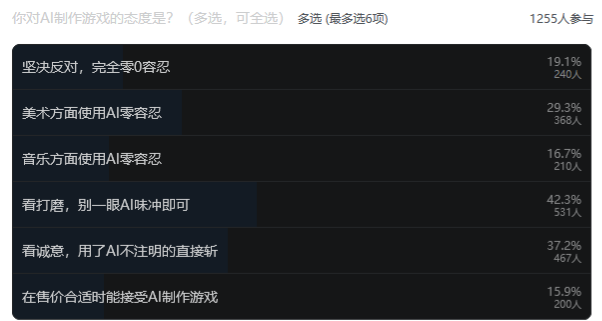
Here’s the translation, from top to bottom:
Attitude on Use of AI in Making Games (Multiple Choice), 1255 respondents
No tolerance at all (19.1% / 240 votes)
No tolerance for AI-generated art (29.3% / 368 votes)
No tolerance for AI-generated music (16.7% / 210 votes)
Accept games that use AI-generated assets refined by humans, to the point it isn’t clear AI was used (42.3% / 531 votes)
Accept games that use AI-generated assets if it looks like genuine effort was put into the game and was properly disclosed (37.2% / 467 votes)
Accept games that use AI-generated assets if the price is right (15.9% / 200 votes)
You can read the data above, so I’ll make some observations:
It seems the minority, at roughly 1/5th of all respondents, do not tolerate the use of AI at all in making games (remember, the language model kind, not the simulated entities kind).
Additionally, there are very few gamers that would buy into games that use AI based on pricing alone. The majority of respondents think polish and sincerity/disclosure are much more important factors to accepting a game using AI.
Also, there are nearly twice as many people rejecting AI-made images compared to AI-made music. I theorize this is because you can just mute the game and play your own music in the background, but I couldn’t find any comments regarding this. Your guess is as good as mine.
We also ran the same poll on our Japanese Twitter/X account (go follow us there too!), and here was the result.
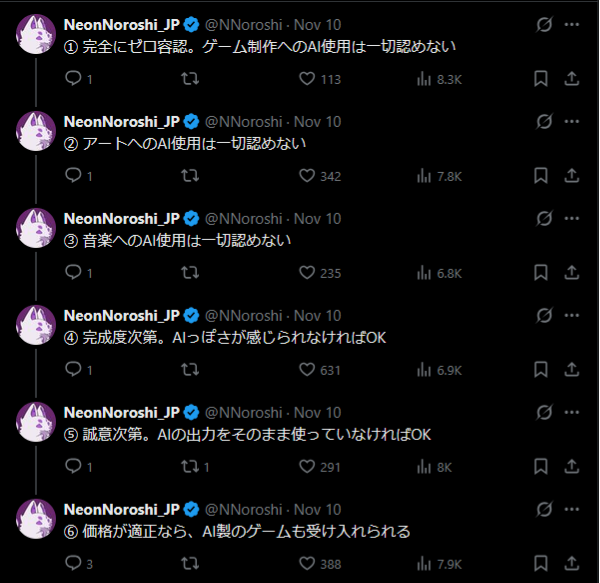
(It’s in the same order as above, Likes indicate votes.)
It’s not exactly possible to determine to total number of respondents, so it’s helpful to look at this as ratios. Again, the minority of gamers (with the lowest total likes) have zero tolerance for AI, more people disagree with AI images than AI sounds, and people are at a 1:4 ratio of rejection:support if you’re sincere about its usage and use it well.
Although, it seems our Japanese audience is a lot more focused on the pricing of the game!
Finally, we ran the same poll, again, on DCInside (Korean social media. As always, follow us if possible)
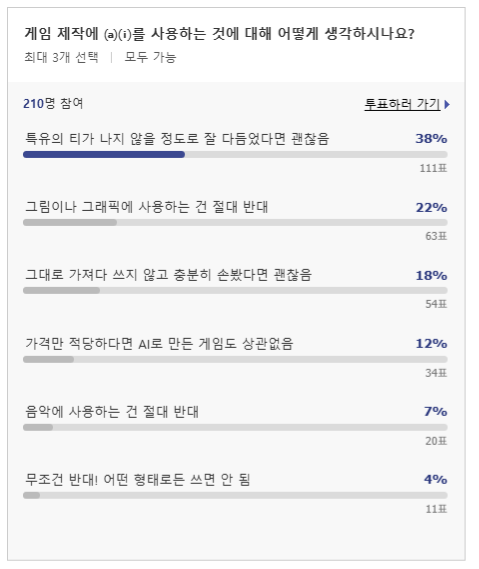
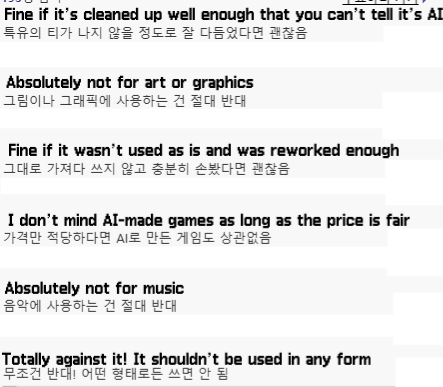
Interestingly, on the Korean side, there is an extremely small minority that’s against AI-usage in its entirety, although they still heavily disapprove of its use for visual assets. Although, yet again, the disapproval for AI-images is still way higher than that of AI-music.
The common sentiment is that AI is okay when used for repetitive tasks, like programming, fixing bugs or translation. As for what assets are more contentious, players generally prefer AI not be used for main art (background art can be okay on a case-by-case basis), story, or character design. For most, that’s not because of the use of AI perse, but rather the lack of polish. Gamers are okay with AI in games as long as it isn’t noticeable. If people see a poorly written story, or AI-generated art mistakes, they will immediately lose interest.
Overall, a grand majority of gamers choose not to buy games that look very obviously AI-generated from the get go, but there are a considerable amount of people that are forgiving of it if the technology is refined by a human hand and the developer is honest about its use. And of course, the game will still have to be attractive too!
If you choose to use this technology in your own game, be honest and use it well.
Catch you soon, we have another poll to cover!
Bonus: With great power comes great responsibility
So here we are again. It’s always such a pleasure.
Alright, I hear you. The usage of AI is heavily, heavily opinionated right now. You can just search up “AI game” and find endless amounts of arguing for and against, and both sides have very good points. My thoughts on it? Well, that is not, and will never be, the purpose of these blog posts. I won’t tell you how to think, I’ll just tell you how it is.
I would like to make clear that this blog post isn’t telling you to swing either way on this topic. You can be pro-AI, anti-AI, or just don’t care. In fact, that’s the main point, the findings were about showing that everyone has different feelings about the topic. We all come from different walks of life, and nobody knows everything.
The reality is that this technology is upon us. What you choose to do, or choose not to do with it is your own discretion. For some, there’s a lot of benefits to using this technology. Many people use it as a lookup tool, a programming learning aide, or other various purposes. Likewise, there is no free lunch, and there are real costs to it too. Many people have lost their jobs over it.
In the hands of the free market that is the Steam Store, however, the principles of marketing and demand still hold. From the results above, if your game uses 100% unrefined AI-generated assets, don’t be shocked if people skip out on it. Having an appealing game is not as simple as just prompting your way to success. Don’t be afraid to put a part of yourself in your work - that’s what makes it your own.
