In 2025, members of Hansicgu, the largest Korean online community for fan-made game translations, posted 159 new translation mods. In October 2026, with two months of the year still to go, 1,763 new mods were posted. More than 1,000 of those were made entirely by AI, with zero human input.
Fan translation is nothing new: Minako O’Hagan traces the early history of the practice to Japanese anime fansubs in the 1980s and argues that it has become a widespread, global form of fan labor with the development of the internet. Similarly, the history of modding goes back decades–players have been tinkering with games for almost as long as games have existed. In as early as 1962, there were recorded instances of university students modifying Spacewar!, one of the very first computer games. And now in 2026, we are witnessing in real time how the advent of generative AI is rapidly changing the modding scene. Fan translation mods are not an exception. In this post, we look at why fans translate games, how fan translations are made, what AI has changed, and finally, what it all means for developers.
Why do fans translate games?
The short answer is: availability. Some fan translations are created with the intention of “fixing” an official localization. For example, Korean players new to Outer Wilds are often recommended to install a fan-made re-translation mod because the official Korean localization is widely criticized for inconsistencies and mistranslations. However, most fan translations fill a gap where no official localization exists at all.
This makes indie games a popular target for translation mods. Small teams rarely have the budget or capacity for multilingual support. Even a commercial and critical success like Disco Elysium originally launched in English only. Developer ZA/UM later collaborated with fan translators and professional translation experts worldwide in a campaign called “The Great Internationale” to bring the game to a wider audience, and the game’s Final Cut edition eventually supported 13 languages.
The localization gap isn’t only about team size, budget, or popularity. Data published in 2024 by a Sweden-based localization company LocalizeDirect showed that more than a third of its 2023 orders involved translating from English into one of the “FIGS” languages: French, Italian, German, and Spanish. Brazilian Portuguese, Simplified Chinese, Korean, Arabic, Japanese, Russian, and Traditional Chinese followed, each making up less than 10% of the company’s work.
Yet, the ten largest gaming markets in 2023 were the US, China, Japan, South Korea, Germany, the UK, France, Canada, Italy, and Brazil. While this is only one company’s data, it does point to an obvious mismatch between market size and localization availability–China, Japan, and South Korea all outrank Europe’s biggest markets, while their languages are less common localization targets. In many cases, fans are stepping up to fill that gap.
How do fan translations work?
Part translation, part “hacking”
Game localization scholars Carmen Mangiron and Minako O’Hagan call unofficial game translations “translation hacking”. They note that translating a game is usually a group work, with a programmer and a fan translator working together.
This is because translating the text is only half of the job. Unlike translating a book, the text assets must be extracted from the game’s files and then packed back so that the translation shows up in the game. In other words, no matter how good a translation is, one cannot make the translated text appear on screen without some programming.
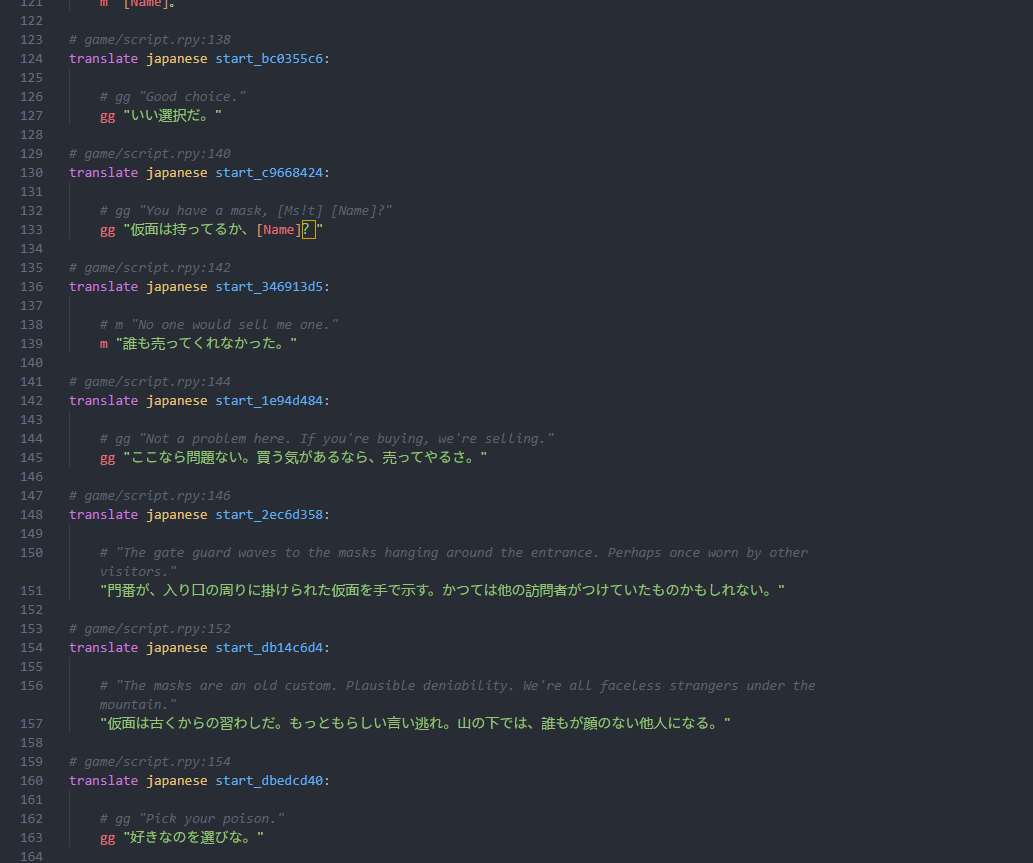
Code for a proof-of-concept translation of OBSCURA. Even a game engine that makes translation easier such as Ren’py requires knowledge a baseline of technical knowledge.
There can be an extra technical hurdle when the target language uses a different writing system from the ones officially supported by the game, such as translating an English-only game into Japanese. The game may not have fonts that can display the unsupported language, so new fonts have to be modded in as well.
Therefore, a common setup for translating a game has a programmer acting as the project lead. They extract the text, convert it into a format that allows online collaborative work (Google Sheets is a popular format), recruit volunteer translators, and mod the translated text back into the game. Games built on popular engines such as Unity are naturally easier to translate since they have well-documented modding tools and tutorials.
Made by fans, for fans
The only requirement for joining a fan translation project is being a fan with the time and enthusiasm to volunteer. More often than not, participants lack professional linguistic abilities, but they make it up with their knowledge of the game itself.
As Mangiron and O’Hagan point out, professional localizers often work under constraints, leading to situations where they have to work without the full context of the games they are translating. In some cases, they may not be gamers at all. These problems are especially more likely to occur when localization is outsourced. On the other hand, fans who care enough to translate a game themselves are less likely to make errors that come from missing context.
The labor of love
Like other mods, fan translations sit in a legally grey area. Each developer differs in how far they tolerate mods, but most EULAs prohibit modifying and distributing game assets, as well as making money from them. Furthermore, modding console games requires jailbreaking, which adds another layer of legal uncertainty.
As a result, fan translations are distributed for free. Attitudes towards donations vary between communities. In many East Asian fandoms, fan translation is seen as a labor of love, and asking for money tends to be frowned upon. There have been attempts to bring crowdfunding to fan translation, but they have been largely unsuccessful. Examples include a 2023 project by nicolith, an English-to-Japanese translator who has worked on both official and unofficial visual novel localizations, and the “Chinese Localization Support Project” organized by 核心玩家大川. Neither ultimately caught on, and the latter was shut down after a community controversy.
English-speaking communities tend to be more relaxed about donations. It is not uncommon for fan translators to include a link to their Patreon or Ko-fi pages on social media or in their profiles on modding sites such as ROMhacking.net.
Generative AI and fan translations
The advent of generative AI in game development has been met with both excitement and unease, and the modding scene is no different. As of 2026, a quick Google search brings up a plethora of AI-assisted modding guides. A PCMag article describes how someone with no coding skills used a subscription to a frontier LLM model to “make pretty much whatever mod you want”; a GitHub project called “universal-modder” claims to let Claude mod almost any PC game you own. Of course, translation mods are very much part of this trend.
Fan translation is both a technical job and a work of amateur translation, making it especially suitable for AI assistance. To illustrate the impact of AI on fan translation mods, I analyzed the number of translation mods posted on Hansicgu from the beginning of 2022 to 21 October 2026. This was done by looking at the combined number of posts on the two boards within the forum: 회원: 한글화 소식 (“Members: Korean Translation Mod News”) and 회원: AI 한글화 소식 (Members: AI Korean Translation Mod News”).
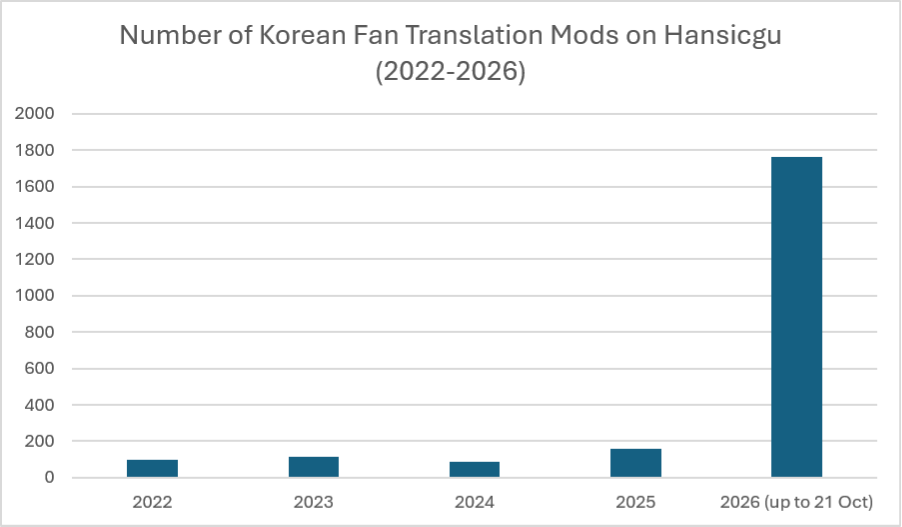
The massive jump in 2026 is immediately noticeable. The number of fan translations rose from 159 to 1,763 in 2026, more than ten times as many, with two months of the year still to go.
Generative AI was popularized in 2023 and quickly became a common tool for translators. Even so, it did not noticeably increase the number of translation mods until 2026. Until then, AI-assisted modding still needed a lot of human hand-holding, which was a barrier for many would-be fan translators.
Then, in 2026, advances in AI coding agents and official AI support in popular game engines, such as Unity AI and Epic’s AI assistant for Unreal Engine, enabled AI models to read and modify game assets directly. In other words, AI has now lowered both the technical and linguistic barriers to fan translation.
A closer analysis of the data from Hansicgu shows just how widespread AI use has become in fan translation. Of the 1,763 mods announced in 2026, 1,097 were classified as “AI translation mods”. Hansicgu defines these as translated and coded entirely by AI, with no human input. And since a mod needs only a minimum of 10% human input to be labelled as non-AI under the forum’s rule, the number of mods that used AI in some capacity is much higher.
Despite ongoing debates on the ethics of AI in modding, AI translation mods have found wide acceptance in many fan communities. Human translations are still considered superior, especially for story-driven games, but the general sentiment is that an AI translation is better than no translation at all. AI is also extremely fast: a full game can be translated in a matter of days, which is a huge draw for gamers wanting to experience the latest releases as soon as possible.
What does this mean for developers?
So what happens if you are an indie developer, and a fan messages you on Discord to say that they have translated your game? It depends. Every developer sees mods differently.
Translation mods are a little different from other types of mods, though, because they can directly make your game more accessible to a wider audience. This is why many developers have openly endorsed fan translations or even adopted them as official localizations. At the same time, there are good reasons to be cautious when endorsing fan translations.
Quality is hard to check
Developers usually cannot judge the quality of a translation in a language they do not speak. And since fan translations are amateur work, their quality varies. Some translators leave the entire job to AI. Even with human proofreading, the time, effort, and language skills involved differ from one translator to another.
Endorsing a poor translation can hurt a game and developer’s reputation. Doloc Town, an indie farming sim by RedSaw Games Studio, adopted a fan-made Korean translation as its official localization a few days after launch in August 2026. After multiple players pointed out problems with its quality, the fan translator acknowledged that it was largely an AI translation with little proofreading. The studio responded quickly, releasing an updated Korean translation less than two weeks later. Even so, the top Korean reviews on Steam still mention a low-quality Korean localization as of November 2026, almost three months after the issue was addressed.
Ownership and legal rights
Adopting a fan translation as an official one can also raise legal questions. In a 2020 Gamespark interview, anonymous Japanese fan translators stressed that developers and fan translators should agree on clear terms at the start of any project that might become an official translation.
One interviewee noted that since fan translations are group efforts, it can be difficult to determine whether the rights for a translation belong to the project lead or to every contributor. This is further complicated by the fact that fan translation projects are organized online, with participants using their online personas rather than their legal identities. In addition, it is often hard to accurately measure how much each participant has contributed to the project.
Final thoughts: Working with fan translators
Fan translators have been filling the gaps that official localization leaves behind. For developers, fan translations are both an opportunity and a responsibility. When working with them, there are several things to keep in mind:
Agree on terms in writing if you plan to adopt a fan translation as an official one. Make sure every contributor is on the same page, not just the project lead.
Check the quality of the translation as best as you can before openly endorsing it or calling it official. Ask the translators how AI was used.
Credit contributors. Consider paying them if their work officially becomes a part of your game, even though many fan translators are willing to donate their work.
Make your game easier to translate if you welcome fan translations. Keeping text assets accessible (e.g., putting them as a .txt file) and having font support for non-Latin scripts make fan translators’ work a lot easier.
A fan translation can bring your game to a whole new audience, and collaborating with fan translators is a fantastic way to build stronger relationships with players around the world.
About the writer: Hyerin Shin is a PhD candidate at Waseda University, Japan. Her research interests include East Asian translations and adaptations of Shakespeare, utopian studies, and game studies. She has worked on both professional and fan translation projects, and she currently serves as a senior editor at Press Start, a student-led, international peer-reviewed journal for game studies.
Twitter: @helena714